
Our Partners *by nature
- Desiree Driesenaar
- 3 days ago
- 4 min read

We work with pearls of the Dutch circular economy. And we write for them about system dynamics. We analyze ESG reports together with our partners. In this article, we want you to meet some of them. Brilliant technical biomimicry and energy-efficient technology. It boasts a clear, passionate business case within the waste-is-food chain. Solutions that were once complex suddenly become simple.

This is *biomimicry. The pistol shrimp uses a bubble of vacuum (physics) and pushes with one blow through the sound barrier. Circular economy machine engineered by our partners mimic this process and thus ensures that the sonic wave technology is 20x more energy-efficient than normal sonic waves. One fierce push and the sound barrier fix the process.
In biomimicry, we let nature (physics) do the energy-work for us. Biomimicry is the #1 innovation technique right now in the world just because of that. Energy congestion, energy efficiency!
The Dutch industrial sector has a circular agenda: 2050 Circular. Now that chemistry is increasingly being replaced by biochemistry as a welcome development, new challenges arise, such as fire safety. But these can be solved with system thinking and physics—design, architectural bridges, and material combinations. Our partners lead with design, engineering, and material science.
Sonic Waves Technology
Venturial mobile machines have been around for several years now. They dry, separate, and pulverize waste streams for creative reuse as powders. What does a Venturial do? Briefly explained? Supersonic. And sonic boom. *by sound.
The circular economy always keeps value longer - if possible, even forever - inside the system. No capital destruction. Venturial converts all kinds of organic and inorganic waste into dry powder, giving designers in the waste-is-food economy their complete design freedom back.
The machines are drying-separating-pulverizing machine with physics - push through the sound barrier – sonic boom technology. Based on the bubble and shockwave of a pistol shrimp. The machine uses 20x less energy than standard sonic wave technology. That's what biomimicry always does: hyper energy efficient.
Regarding system thinking: all materials in a lifecycle analysis (LCA) can be calculated with one value: energy. In a circular economy, supply chains are shortened. Regions gain an abundance of healthy businesses. Laws are simplified and adapted to a biomimetic, design-savvy, energy-efficient and energy-abundant 21st century. Just think energy = data = process and you understand. Energy is everything. Nature is spatial relations math, biology, and physics.
Drying in the Supply Chain
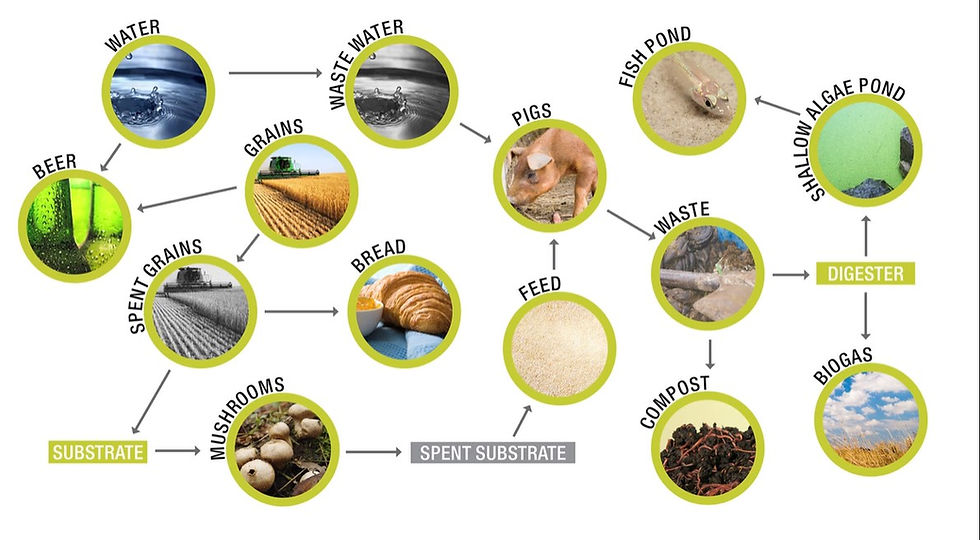
Drying: is combined with biodigesters, the energy suppliers of the Netherlands. For example, Dutch farmers ferment their own organic waste locally and can now dry and recycle slurry for innovative, clean manufacturing. Ecosystems-thinking and all big, polluting energy factories can close their doors. Waste is energy.
Separation: If the Netherlands wants healthy materials, material passports are needed. Materials with, for example, toxic paint are classified differently from clean materials, so choices can quickly be made regarding what can be reused according to NEN standards. Air pollution accumulates more in an indoor environment than on the exterior of a building exposed to wind. Material passports ensure that the value of materials is retained, for example, throughout a building's long lifespan. Maintenance becomes cheaper and rest value can make a building faster profitable.
With material passports, residual waste value, normally pollution, becomes a source of income in a circular growth economy. Healthy and growth of local macro-economy.
Pulverization: With pulverization, designers get their creative freedom back. Powder is much easier to process into new materials than, for example, entire wooden walls.
For instance, a visionary German architectural team from Stuttgart and Berlin is pursuing a path of biomimetic metamorphosis with two flexible membranes. And light, sound, and ventilation are regulated healthily *by design. Not by machines that need filter maintenance. Transforming a sick-building syndrome building into a renovated, beautiful, and healthy structure with two new snakeskins. Cylindrical math *by nature.
The EU has a subsidy agenda for adding more biobased fibers to materials. Reused farm waste or fiber cultivation. Bamboo. Elephant grasses. Miscanthus. It reflects and does not blind pilots at Schiphol Airport than solar panels and keeps geese at a natural distance.
Healthy Fibers Instead of Polluting Steel?
Fiber polymers can be stronger than steel and non-corrosive. Has this closed the loop on Tata Steel and the steel slag problem? Time for a clean materials campus near Amsterdam, inspired by Limburg? Time to save 2 billion euro in subsidy for a process that will never be healthy, whereas *by design is doing the same work elegantly and give vehicle builders a lightweight alternative to steel?
*by planet only a few abundant substances are used and designed in open structures for functionality. Bones are almost the same material as skin. Open in structure. Tensile strength, hardness, or flexibility are merely different organizations of structures. That's all. We can mimic this easily with biobased powders.
Young Designer Dreams
Young designer dreams are becoming simpler and fully circular! Nature is always evolving in young, modern futures. And with today's 4D design computers, rethinking like nature has become easier. Natural principles such as metamorphosis, physics, vacuum bubbles, splitting and deposition, biochemistry, composting of residual materials, and everything "timed degradable" are the future for a healthy humanity. Because pollution is just accumulation, a buildup of (too) harsh substances.
Timely transformation into powder and new design freedom is a MUST! We do, of course, live in the Anthropocene. Systems thinking and *by design are indispensable human 21st-century skills.
Meet the people inspired by our fascinating planet, and natural processes!
Dear creative designers, dare to explore more with system dynamics...

Comments