
My Work in/for the EU Union

On request of my multiple clients, who often cannot see the wood for the trees in my broad and deep career of economics, regeration, and sustainability for local area abundance, I have made a recap of my 35+ years systemic design experience. I thank all my wonderful colleagues in the different international projects and hope to contribute some more before my pension in 2033.

Name: Désirée Driesenaar - Consultant, Dutch Designer
Strategic Management, ESG, Data-Driven, Regeneration-Sustainability, smart-healthy towns, sector transitions
Locations: The Netherlands & Greece, half-half Born: 1965 ~ The Netherlands Contact: desiree@driesenaar.nl
Since 1987, I work as a woman on management boards, logistics, high-tech, circular economy, biomimicry, sustainability design, education and ISO-consultancy.
For details: see my LinkedIn profile: https://www.linkedin.com/in/desireedriesenaar/
In a Nutshell:
Education: primary, secondary, and preparation university education, featuring math, economics, languages, cultures, Latin, Greek, and more. Broad interests.
1983-1987 – Saxion University of Applied Sciences - BASc in international business
2010 HU University of Applied Sciences Utrecht – post-bachelor strategic communication, journalism, change-communication
from 2014 - courses in circular economy, biomimicry, Systems View of Life (Capra), etc.
Relevant Experience:
1987-2007 – Strategic Boardroom Roles in NL and UK corporate and large SME, logistics, plasma-vacuum technology, media, education companies.
2007-2014 and beyond, in total 10 years – IHI Hauzer, part of IHI Corporation – Dutch Japanese – physical vapor deposition. International business developer and innovative B2B marketing manager in this Dutch-Japanese company. Responsible for budget, Dutch, Japanese and Chinese B2B marketing teams reporting to me.
End of 2011, I founded a DesignTank for Economic Modelling, Sustainability and Biomimetics. Systems not Symptoms. Because nature finds in 80% of the cases different solutions than current mechanical engineering. And “integrated finance” helps to finance cross-sectorally and give healthy sturdy business models for longevity of an area’s progress. Budget combining. Always multi-profitable.
My biggest inspiration was one graph and in 2014, I started fulltime initiating and designing sustainable projects with Dutch Design circular economy colleagues, biomimicry, architects, designers, data and math teams. This is the inspirational graph, comparing nature (biology, physics) and mechanical engineering. The biggest difference is energy transformations at different scales.
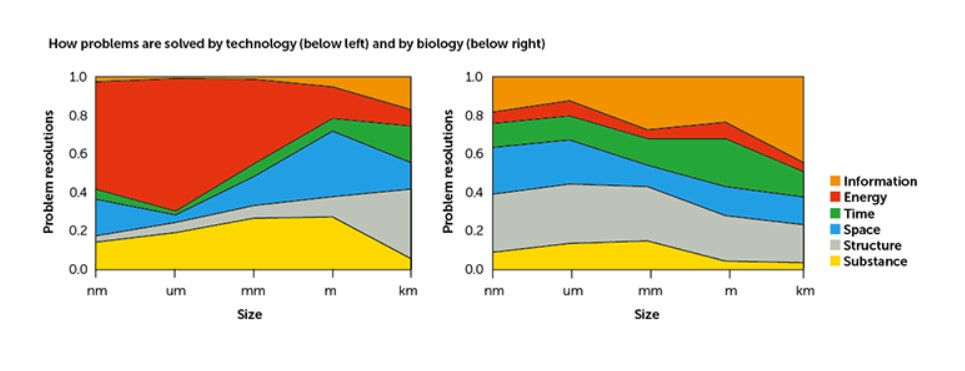
Research: biomimetics engineering professor Julian Vincent et al – for healthy architecture, city designs, and nature-based solutions – credit The Royal Society.
As an independent sustainable business development consultant and educator, I always use the gap-analysis method for a local area and plot in all the nature-based and digital solutions I came across in my longstanding international career.
We built consortiums, found public-private funding, made innovative business models for sectors, and after 15 years of Brightlands projects, my colleagues and I in Limburg, Netherlands were awarded the ICF Award of the most intelligent, smartest, data-driven area of the world. https://www.intelligentcommunity.org/brightlands-limburg_wins_the_2026_intelligent_community_of_the_year_award_from_the_intelligent_community_forum
We design GLOCAL 4 LOCAL and I do a lot of international ecology-economy education too. Both come from the Greek word Oikos – household. Why would you manage the household (economy) on our planet, when you do not understand the knowledge of our planet (ecology)???
I combine them in one concept:
Healthy people IN healthy buildings IN healthy environments. And to prove progress we must be smart and data-driven with intelligent, digital designs.
I was asked to be a Blue-Green Economics advisor to the EU Commission in 2020, judging horizon subsidies and helping young business teams sharpen their business models for multiple value and broad wellbeing. Also, money-profit - value. Use your waste, validate your waste and design circular movements with proven, fixed value.
Public-Private interactions.
Replace something with nothing in the system.
I taught regeneration in international business schools. My company Abundanism started freelance, became a Joint Venture in 2020 and it is since the pensioning of my partner in 2026 a solopreneur company again. Still surrounded by many inspiring PhD scientists, researchers, architects, doers, dancers, and designers.
Awards won with our/my innovation & economics work:
In 2023 - winner of the AIOTI hackathon in Brussels with Greek Wildfire Guardians, a Web 3 blockchain/ local crypto model with as biggest innovation the shift from punishing to rewarding good behavior of stakeholders. A combination of healthy physical landscapes and digital solutions.
We did a year of researching the stakeholder profile of Peloponnese, Greece, risks, zoning, and business interests – mainly tourism – and designed solutions with biochar, carbon credits, AI for monitoring, and apps for better sector performance.
https://aioti.eu/aioti-signature-event-2023-the-next-frontier-of-the-iot-edge-and-web3-0/ and https://youtu.be/9CeWVFFiLFw?si=6JCihxvmuRkSwr4h


Some of my “systems, not symptoms” projects since 2012:
2012- founder ABUNDANISM MOVEMENT – Minimizing and maximizing design-concepts. Nature-based and nature-inspired architecture of breathing buildings. BREEAM and ISO. Glocal 4 Local. Gap-analysis with SDGs and ESG.
2012-2016 – I was asked by sustainable entrepreneur and visiting professor in Japan Gunter Pauli - the Steve Jobs of Sustainability - to help his ZERI team (zero emission) prepare European local teams before the master-team arrived.
We did design-thinking hackathon sessions at “De Ontdekking van Groningen (NL)”, Blue City Rotterdam (NL), an architectural team in Austria, and our main inspiration, the full basic needs design on the island of El Hierro (Spain). El Hierro is the first fully autonomous regenerative abundance economy on an island (since 1995). Javier Morales was the designer (he pensioned) and I’m still in touch with him and his team.
In 2016, I came to Greece for a keynote in Karyes, Mount Parnon at the World Healthy Innovation Summit (Blue Zones of longevity) and I decided to focus half-half on Netherlands and island countries like Greece and Indonesia since then on.
2013- Foundation Phien, Limburg (NL) - off-grid energy buildings/architecture and 80+ ha food forestry. Broad wellbeing. Abundance food, homes and new villages on former toxic farmland with lily flower crops (heavy pesticide polluted). This project was a documentary in 6 episodes “Building Paradise” on our National TV.
The project was pioneered by my husband Mike Harps in 2013 with his scouting friend and 2 daughters as angel investor funders. The project is now mature and has 4 farms = 80+ ha and 50+ families involved. The funder also funded a food forestry farmer education project and education materials spread over all the general farmer schools.
The financial construct is 99-year land-lease which keeps the costs for citizens ultra-low since they have no electricity bill either. They produce what they use and vice versa. Autonomoous design. Free-of-charge energy concept with more than 1 source of energy. All local. And built by professional citizen-builders. There are 5 building templates for newcomers to choose from.
“It takes a trusted village to raise a child and immune is a design too.”
2018- interim director ecosystem restoration education organization. https://ecosystemrestorationcommunities.org/ The board consisted of big inspirers, such as Kiss the Ground, John D. Liu (Loess Plateau restoration 1995-2005), ecologists of Commonland. A design of regeneration with polyculture business model, and modern data-driven food health. Everything edible! E.g. edible mushrooms (oyster, shiitake) in a corner of the farms for extra income).
2018-2022 – I was a partner in the Dutch-German Healthy Building Movement. Partners are Dutch Cradle 2 Cradle, German biobased architecture expertise, and University Maastricht (Professor Piet Eichholtz, health-realestate-finance).
The model featured healthy materials, no indoor offgassing, breathing building designs with termite ventilation, circular water, passive for energy, autonomous for food needs, cleaning outdoor and indoor air with NASA-chosen plants (benzene/toluene), etc. Ultra-innovative. Combined with the economics of ROI Year 0.
Variable costs in the system, material passports for reuse, even after 40-100 year, budget combinations, solving costs with income into the system. Connecting flows.
In 2015, the model had been proven for Venlo City Hall, a primary school De Zuydstroom, a sports facility and a Van der Valk hotel that produced its own food too. We made the complexity simple in expertise websites in German and Dutch, webinars, solutions journalism, events, and interactive location visits, so all Dutch and German architects and builders could make their profitable business models with the ROI Year 0 concept and sector transition scaling all over Europe would speed up.
Research is one thing, but our DesignTank Abundanism focuses on local implementations. Circular Economy, Health and Finance designs: https://www.ellenmacarthurfoundation.org/circular-examples/city-hall-from-cradle-to-cradle-venlo

One thing we later talked about with the Dutch governments is how to solve homelessness by giving homeless citizens a registry address in the city hall. They get access to benefits, insurance, doctors, debt release, and education and the government knows better what their issues are.
The city hall could also have been made fully multifunctional and bio-metamorphosis – used by day for civil servants, by evening for adult education, by night for homeless people. 24/7 – 100% space filling. Morphing building.
Biomimetics LAVA architects – laboratory for visionary architecture in Germany are experimenting with those designs. The most advanced lab with 20 years experience. But the Profitable 4 ALL designs I suggested were never implemented, as far as I know.
Abundance 4 ALL. Distributed health and wellbeing.
The science of measurable health and longevity in Blue Zones is of course a bit more complex than just a building, but the medical epigenetics research feeds on it.
Maastricht University keeps the datasets (since 2015) and transfers data to human health baselines for our smart Limburg area. It provided a lot of generalized input for the Maastricht Health Campus, as well as for our Limburg medical system, when employees in the city hall and the other healthy buildings gave their permission. Of course, privacy of data is a huge issue here, but Limburg did not become for nothing the smartest region of the world, concluded by ICF.
Datasets are securely arranged and monitored by Dutch Design technology.
2020- advisor EU Commission – Blue-Green Economy horizon subsidy judge.
2020- island economics keynote and staff education – train the trainers - in Green School Bali. Bali is one of the most advanced places for regenerative designs and bamboo architecture in tropical areas. 1500 documented bamboo use cases. 2.5 billion people worldwide dependent on bamboo. We visited the bamboo labs.
Mike and I combined those 3 months with the Indonesian locals with exploration of the Cosmological Axis (Unesco) in Java, Yogyakarta and exploration of my ancestory.
I’m Dutch-Indonesian with local connections.
2020 - we also visited the Ecoshape – building with nature – project in Demak, near Semarang Java to see for ourselves how the nature-based solutions progress of mangroves went. Acquiring land with a simple methodology: sustainable fish farms and mangrove restoration by sediments, not planting. 20 years of proven methodology. Easy maintenance for the locals. A simple bamboo wall. Food security by transitioning to vegan kroepoek, made of mangrove leaves.
Production and consumption as much as possible in one area making nature productive in a healthy way.
In 2020, When Mike and I returned from the tropical ecosystems of Indonesia, I wrote a gap-analysis-report and consortium strategy for the Ecoshape team of Witteveen+Bos (water engineering), Dutch water ambassadors (including our King’s successor), Wetlands International (Ede), and the dredgers Van Oort and Boskalis. Focus: coastal protection, enough drinking water with non-extraction (desalination and condensation), food, non-sinking villages, accessible education for Indonesian locals. Water-flows and data-flows.

From 2020-2022 I have been working with my colleagues on 5 different designs for Maas river port health over 3 design lines:
water-biodiversity
autonomous renewable energy options other than windmills, such as thermodynamics in harbor walls (Crux) and biomass from local farmers’ waste (pyrolysis for the biochar soil enhancements and financial carbon credits).
multimodal transport with an app for efficiency and return loads.
Maybe that last digital design – multimodal transport - explains the math of abundance best: 1 app for return loads will result in:
transport cheaper for the customers (profit ⬆️)
more profitable for the transport companies (2x less = more ⬆️)
we saved 30-60% carbon emission in the model, sustainability ⬆️).
Planet – People – Multiprofit everything abundance, it's a design.
The project was called Rhombus Sustainable – 5 healthy Maas-river ports. Gap-analysis and landscape solutions, digital design and data solutions plotted in too. Partners: IBI2 and Arcadis.
I had been working with the owner of IBI2, Sandra Baan, a sustainable Dutch Designer and biobased materials expert since my Abundanism start in 2012.
We had been doing many years of “Duurzame Dwarsdenkers” – ultra-innovation education, things like polymers with enzymes for “strong during lifespan and biodegradable after” - in the Brightlands campuses. Biobased and bio-inspired designs.
Netherlands-Germany is ultra-energy-efficient and ultra-innovative in open, sharing education collaborations. Cross-sectoral consortiums are normal in NL.
2022-2024 – In 2022, Born Global Inc (USA) asked me to prepare their European students for the COP with Greek archetype inspiration - the yearly UN sustainability gathering. Born Global students are taught biomimicry and they did awesome projects with sustainably sourced perfumes. We had a French “nose on the team”, sourced form Firmenich/DSM food grades, and also made healthy building indoor air quality perfumes. Other teams made non-explosive vessels for the hydrogen transition agenda, etc. Many teams. Many solutions. I focused it on European landscapes.
The Born Global Foundation also involved me in educational projects with NFTs for artist business models and we nearly made a Netflix filmscript with the awesomely talented young filmmaker Tia Samaha. I hope it will come to a follow up project someday.
From 2021 onward, I did model-design-work with Greek teams. Sea-gap-analysis is done by the Argolis Gulf NGO. We had talks about how the data of Pelagos Science Institute (whale communication and blue resonance) could be used for ship industry innovations benefiting dolphins and whales too. A sonar-light-aura for a ship made by data to prevent whale-collision was discussed with the ZERI-team.
We did farmer-food abundance with our project Olive Bliss - high polyphenol olive oil and antioxidants. We worked with the Peloponnese Living Team in Arcadia - tourism accommodation association - on more income in the off-season. We built a Facebook group (90,000+ Greece lovers to serve for local Greek entrepreneurs as their marketing-tool) and a young Greek AI designer – founder GrowApps – joined our Greek accommodation team for even better, more modern results.
A longstay off-season concept targets pensioners, snowbirds, digital nomads, remote workers and solo travelers. A lot of – female – solo travelers do not feel safe, and we give them a safe space and local community. The Greek hosts organize monthly gatherings in the Peloponnese area of Astros and provide tours to Greek hidden gems. They grow their income with the Peloponnese Living project.
Money is innovatively flowing INTO Greece, not OUT of Greece.
As said earlier, in 2023, we won the science design hackathon with a Greek Wildfire Guardian Project. Greek AI, Greek mathematicians. UK-Dutch landscapers and Greek, Austrian and Brazilian AI and DeFi designers.
In 2026, we did a follow up IGNIS-LINK project with the Biomimicry Math Superformula of everything - hardware and software - Gielis Superformula, to see if we could get funding from ESA for an independent AI-software module predicting fire speed in mountainous areas. The interconnection of local landscape and digital is still a problem in the whole real-time latency issue of monitoring.
The 2026 consortium consisted of Genicap.com (NL), Indicia.com (NL), and Fossa.Systems (Spanish picosatellites in swarms, also designed with a biomimetics Gielis Superformula (Genicap NL). A closely knit team of ultra-innovative mathematicians and designers of physical and digital.
We do need a European AI and independent data-agenda!!!!!
Especially now that we are politically hijacked by USA, America and China!!!!
Fossa had won the European ecosystem constellation contract for the Spanish-Atlantic constellation. https://fossa.systems/press/fossa-systems-wins-iot-ecosystem-contract/ But our ESA funding failed. Maybe next time. The consortium still exists.
This is the scientific Gielis-Superformula of biomimetics, energy efficient data transfer to limit the need for big datacenters in digital solutions like AI, AR, VR, etc. We cannot allow the world to need big data centers causing heating, draught and destruction.

I promised myself that Abundanism will always design in the frontrunner position of Healthy 4 ALL with ultra-innovations and systemic designs for local areas. And since energy is the common denominator in an LCA, biomimetics - system dynamics - math professor Johan Gielis and I participated with a Groningen colleague in the 2024 SYNERGY-energy hackathon in Delft.
In 2025 and 2026, I was asked by Sandra Baan and her Dutch Design materials team to help explain the farmer/food/building materials solutions to our Dutch government. We have 60,000 ha of Dutch farming in transition.
We have a huge nitrogen problem and the farmers need economic solutions without subsidies. Subsidy hopping is never a long-term solution.
So, in my gap-analysis and report, we combined many sectors and showed the cross-sectoral business models with margins and numbers. Local material choices that fix carbon and nitrogen (clover instead of grass, lupine instead of corn, beans – they are all nitrogen fixers). We used well-documented circular economy and regeneration methods like terra preta (carbon added, biochar made for organic waste for longer living soil – the nano holes are shelter for the microbes).
We connected carbon credit DeFi methods to that model for farmer income without subsidy. We dry manure with a 20x more energy-efficient sonic process (biomimicry) and we ship no water, a design as lean as possible. We connected builders and farmers in a Blue-Green consortium so the fines (300 euro/kg nitrogen) could be directly connected to the farmer costs as farmer income, subsidy saving...
The farmers need more income for their transition. The builders want to innovate, renovate, split, finish, build, and not be fined for something that’s not their fault.

The report was full of calculations done together with the farmers-food-builders consortium.
Venturial – biomimetics doen by Sandra and Stefan Baan played a crucial role in the LCAs. The Lifecycle Analysis. Biomimetics drying, analysis, and pulverizing. So that a material passport costs as little energy as possible. It also gives the circular economy designers full design freedom back. Not a whole wall reused.
Just material to make e.g. fashion out of coffee waste fibers or out of building waste.
Enzyms in the materials count for “strong during lifespan and biodegradable after”.

Made with and for Venturial – IBI2, Sandra and Stefan Baan in Brightlands.
Soil farmers can have a stable income from carbon credits, even when their harvest fails due to climate change. The building materials were of course connected to the healthy building projects and smart-healthy town projects from before in my career.
In 2026, I was asked by an Extremadura (Spain/Portugal) team to connect a holistic grazing project to carbon credits, gene-edited fire-prone sheep, and keeping water longing in soil (biochar soil wildfire prevention). I told them that gene-editing is not safe for humans, so together we found the best local, hardened sheep races, and they are designing the AI-latency digital monitoring and carbon credit future for the area now.
In essence, everything is ready for a big upscale in Europe and export to other world areas. In Greece, they chose an OroraTech (German) wildfire monitoring AI contract with a latency of minutes, so perhaps The Genicap/Fossa team will succeed to shorten that latency to seconds in Spain. The Greeks are the first to use dedicated satellites for the data-deployment.
And I’m super proud to have chosen Greece as a focus next to my Dutch focus.
Pythagoras and Pythagoras +++ They belong together with the SOLL-IST gap analysis methodology that existed in Dutch and Germany long before computers took over.
End of 2026, I was asked for a Greek design project that made me go hugely feminine and dancing with Abundance 4 ALL again. Greece has the spotlight project for European healthy smart cities. The Ellenikon project. Blue-Green Buildings and city design by the sea.

An old, degraded airfield 3x the size of Monaco is transforming since 2021 in 44% green instead of 11% green (old Athens). Solutions for abundant food (everything edible), sustainable transport and relaxation in a cool city. Healthy residential areas interact with commercial areas. Tall apartment complexes and commercial supply logistics.
Circular water supplies. Abundance energy solutions.
But this project has one big disadvantage for Greek people. It is a privately developed commercial and residential regeneration project led by LAMDA Development that focuses on market-rate, mid-to-upper-tier, and luxury housing.
So, next CEO Carly Gianakas of UnderGreekSun.com asked me if we could ADD to that model for the underprivileged women of Greece. Greeks do not want to just sell out their best part of the city to rich Sheiks, Chinese, and overseas and have nothing to show for their own underprivileged citizens.
Carly has a big visionary dream to change the full Real Estate sector with eSg. The social as well as the environmental side of things. That was a new one for me. Social.
Under Greek Sun focuses on selling real estate - their property expertise. They have a one-stop-shop for investors and buyers. Keeping them safe with an in-house lawyer, introduce climate risk assessments and comparisons, surf the Greek bureaucracy, enter state-of-the-art healthy architecture into Greece and make sure that data proves what we promise.
The other side of the company-medal is an NGO: Thalpori. With Thalpori, Carly and her Greek real estate and data team will arrange renovated apartment blocks with a central shared spaced and fund it in such a way that the rental is affordable for women in domestic abuse situations. I help the team design the data flows, make the reports, and enter in all we learned from Netherlands and Germany about healthy people in healthy buildings in a healthy landscape.

In Thalpori, we have 2 taglines:
HOME SHOULD NEVER HURT – healthy homes, no domestic violence, and healthy landscapes that the homes reside in.
WOMEN ARE NO PROPERTY – well, that speaks for itself. Women should be supported to be independent and have options when they want to keep their children safe and when they want to leave abuse, they should be able to afford housing with some sisterhood. Thalpori offers just that. A place to go to when your home hurts.
We are working on it with our networks. We hope to join forces with the Ellenikon Project and LAMDA development and perhaps our first Thalpori home can have a place in the luxury project. Social housing has not been included (yet), but we might be able to include it after all.
I will use my network of SDG/ESG designers and the social movement in Greece. The Home of Beautiful Business is already 10 years organizing conferences in Athens.
Last year, autumn 2025, I was asked to hold a talk/short scientific intervention about planet, energy, and biomimicry design at the World Human Forum, chaired by Alexandra Mitsotakis.
Siga Siga, as we say in Greece. Step by Step. The Thalpori project is still young, but if you want to be involved, if I can do anything for your ESG-projects, or if you want to include me for EU Horizon subsidy judging, feel free to get in touch with me.
If there’s anything I do not know myself, I have a huge network of biomimetics, ecology, architecture, sustainable design, and scientists behind me.
Simple Complexity should never be very compicated but an ESG model full of innovation and abundance 4 all. And when the team is diverse and experienced, we can get results faster. Most of what is needed has already been invented, so in my opinion, we do not need new startups, we need implementations, public-private consortiums, and connecting innovative dots.
Abundanism Désirée Driesenaar
Tel. +31 6111 rest on request - hybrid in NL and Greece.


Comments